OPINIONS
America Was Given a Republic. Now It Has to Prove It Can Keep It.

By Chad Dashly | The Current
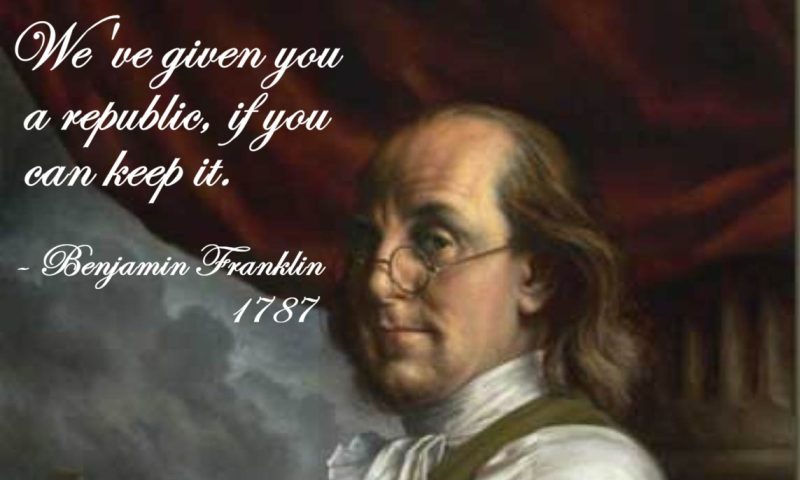
Benjamin Franklin supposedly walked out of the Constitutional Convention in 1787 and was asked what kind of government the founders had created.
His answer has echoed across more than two centuries:
“A republic, if you can keep it.”
Maybe Franklin wasn’t speaking to 2026.
But he might as well have been.
Because America is approaching a moment when voters will be asked a question much bigger than whether they like Donald Trump, dislike Donald Trump, support Republicans or prefer Democrats.
The real question is whether the institutions of the American republic still matter.
On November 3, 2026, Americans vote in the midterm elections. Every seat in the House of Representatives will be contested, along with roughly one-third of the Senate.
Normally, midterms are about taxes, inflation, health care, immigration and whether voters are satisfied with the president.
This time feels different.
This time the issue is power.
Specifically: How much power should any American president have?
And perhaps more importantly: Who is willing to stop him when he goes too far?
The Problem Isn’t Just Trump
Donald Trump remains the most polarizing political figure in modern American history.
His supporters see a president willing to challenge institutions they believe have become arrogant, unaccountable and hopelessly disconnected from ordinary Americans.
His critics see something much darker: a president steadily testing the limits of executive authority while demanding loyalty from institutions that were designed to remain independent of him.
You don’t need to embrace every accusation levelled against Trump to recognize the danger.
Presidents are supposed to have opposition.
Congress is supposed to challenge the executive.
Courts are supposed to interpret the Constitution independently.
The Justice Department is supposed to administer justice rather than political revenge.
The media is supposed to make powerful people uncomfortable.
Those aren’t inconveniences.
They’re the system.
And when those institutions stop behaving independently, it shouldn’t matter whether the president’s name is Trump, Biden, Obama, Bush or anyone else.
Conservatives, of all people, should understand that.
Limited government cannot mean limited government only when the other party controls it.
Congress Has Forgotten Its Job
Perhaps the most troubling development in Washington is not Trump’s behaviour.
It is Congress’s willingness to surrender its own authority.
America’s founders didn’t create Congress to serve as the president’s fan club.
They created three competing branches of government precisely because they didn’t trust concentrated power.
Ambition was supposed to counter ambition.
Congress was supposed to fight for its authority.
Instead, modern American politics increasingly rewards legislators for becoming extensions of their political tribe.
When their party occupies the White House, congressional leaders defend behaviour they would have condemned had the other side done exactly the same thing.
Democrats have done it.
Republicans have done it.
And the result is an executive branch that gets stronger almost regardless of who wins elections.
That should worry everyone.
Because eventually the president you despise inherits every power you were willing to give the president you loved.
Conservatives Should Be Especially Concerned
There is an uncomfortable irony here.
For decades, conservatives argued for smaller government, constitutional limits, individual liberty and skepticism toward centralized authority.
Those ideas were right then.
They’re right now.
Yet parts of the American right increasingly seem willing to tolerate enormous executive authority so long as the person wielding it is Donald Trump.
That’s not conservatism.
That’s personality politics.
A conservative shouldn’t want a Republican king any more than a Democratic one.
The entire point of constitutional government is that good institutions protect citizens from bad leaders—and protect the country from the excesses of popular ones.
If your theory of government depends entirely upon trusting the character of the person sitting behind the Resolute Desk, you no longer have limited government.
You have faith.
America’s Institutions Are Being Tested
There is another problem developing alongside political power: economic power.
America’s technology giants have become some of the most influential institutions ever created.
They control communications platforms, cloud infrastructure, artificial intelligence, advertising networks and increasingly large portions of the information Americans consume.
That concentration deserves scrutiny regardless of whether those executives are friendly with Democrats or Republicans.
The danger isn’t simply billionaires becoming involved in politics.
Billionaires have always been involved in politics.
The danger comes when political power, technological power, financial power and media power become increasingly intertwined.
A functioning republic depends upon competing centres of authority.
When everybody with something to lose decides it is easier to accommodate political power than challenge it, accountability disappears remarkably quickly.
Courage becomes expensive.
Silence becomes profitable.
That isn’t healthy for democracy.
This Is What the Midterms Are Really About
The 2026 midterms therefore aren’t simply a referendum on Donald Trump.
They’re a referendum on checks and balances.
Americans will decide whether Congress should continue marching alongside the White House or whether Washington needs more institutional friction.
And friction isn’t necessarily dysfunction.
Sometimes friction is exactly what constitutional government requires.
Presidents hate congressional investigations.
Administrations hate hostile committees.
Political parties hate divided government.
Good.
They are supposed to.
The American system was intentionally designed to make sweeping concentrations of power difficult.
Government wasn’t supposed to operate like a corporation with a chief executive issuing orders to compliant subordinates.
It was supposed to be messy.
Slow.
Argumentative.
Frustrating.
That’s a feature, not a bug.
America Doesn’t Need Another King
There is a tendency in modern politics to treat every election as an existential event.
Lose this election and democracy ends.
Lose that election and America disappears.
Most of the time, that’s nonsense.
America has survived terrible presidents, mediocre presidents, corrupt politicians, wars, depressions, scandals and periods of astonishing political stupidity.
It will probably survive Donald Trump too.
But survival isn’t the standard.
The question is what kind of country emerges afterward.
Because republics rarely disappear overnight.
Institutions erode gradually.
Norms become optional.
Exceptional measures become routine.
Political opponents become enemies.
Executive authority expands.
Legislatures become spectators.
And eventually people discover that powers they tolerated when their side was winning have become terrifying when the other side takes control.
That is why Franklin’s warning still matters.
Keeping the Republic Is the Voters’ Job
The founders didn’t promise America permanent liberty.
They built machinery that could preserve it.
But the machinery only works if citizens demand that it work.
That means insisting presidents obey constitutional limits even when you voted for them.
It means expecting Congress to act like an independent branch of government.
It means defending courts when they issue decisions you dislike.
It means tolerating journalism that makes your side uncomfortable.
It means accepting that political opponents are still citizens.
And above all, it means remembering that America is bigger than whoever happens to occupy the White House.
Donald Trump isn’t America.
Neither is the Republican Party.
Neither is the Democratic Party.
America is the Constitution.
The institutions.
The separation of powers.
The rule of law.
And the stubborn idea that nobody—not a billionaire, not a judge, not a president—is supposed to be above them.
Franklin said America had been given a republic if it could keep it.
Nearly 240 years later, Americans are still answering him.
On November 3, they get another chance.
Footnote: Chad Dashly has a clear thesis: the issue isn’t whether you love or hate Trump; it’s whether you still believe in limited government when your own side controls it.



By Chad Dashly | The Current
British Columbia has come too far to stay the same.
Unfortunately, at the moment, almost nothing about B.C. politics looks particularly stable.
The province is approaching municipal election day on October 17 while simultaneously confronting the possibility of an early provincial election. Premier David Eby has publicly said the NDP is “election-ready,” citing his government’s one-vote majority, while Elections BC has published contingency calendars for a possible fall 2026 provincial election. The regularly scheduled provincial election is not until October 21, 2028.
Meanwhile, the Official Opposition is going through an extraordinary internal crisis.
The B.C. Conservatives won 44 seats in 2024 and came remarkably close to forming government. Today, the party has 28 seats after nine MLAs left caucus following Kerry-Lynne Findlay’s leadership victory.
That is not routine political disagreement.
It represents a significant restructuring of the opposition benches at precisely the moment the government itself is operating with an exceptionally narrow margin.
Then came another controversy.
It was reported this week that MLAs, former Conservative executives and journalist Rob Shaw had been informed that they were subjects of a private investigator allegedly hired by a former senior Conservative Party official. Findlay has said she knew nothing about the alleged investigation. Those distinctions matter: allegations involving a former party official are not evidence that the party leader authorized or knew about them.
But politically, the episode adds another layer to a larger problem.
British Columbians aren’t watching a normal disagreement over tax rates, health policy or resource development. They are watching institutions and political alliances being tested in real time.
And that should concern people regardless of which party they support.
The NDP’s temptation
David Eby now faces an obvious political calculation.
The opposition that nearly defeated his government in 2024 is fractured. The NDP has recently improved its polling position. An Angus Reid survey conducted September 8–15 put the NDP at 41 per cent, the Conservatives at 37 per cent and the Greens at 13 per cent.
But the same survey contained an important warning against reading too much into the horse race: 50 per cent of respondents said it was time for a change in government, while 51 per cent said they were not enthusiastic about the choices available.
That may be the more important number.
The electorate does not appear neatly divided into enthusiastic partisan camps. There is substantial dissatisfaction underneath the headline numbers.
Calling an election while your principal opponent is experiencing internal turmoil may be perfectly permissible under B.C.’s parliamentary system. Whether voters would view the timing as justified by the government’s narrow majority or as political opportunism is another question entirely.
Municipal leaders are already raising objections.
Union of B.C. Municipalities president Cori Ramsay has publicly urged Eby not to interfere with the municipal election period by calling a provincial election.
She has a point worth considering.
Because something important is happening outside Victoria.
Cities are voting too
On October 17, British Columbians will elect mayors, councillors, regional district directors, school trustees and other local representatives across the province.
These races deserve more attention than they normally receive.
Municipal governments make decisions that people encounter every single day: property taxes, roads, development approvals, housing density, policing priorities, parks, transit, infrastructure and the basic functioning of their communities.
In Kelowna, for example, voters will elect a mayor, eight councillors and four school trustees. Those officials will influence city services, taxation and major spending decisions for the next four years.
Across B.C., municipal candidates are going to face difficult questions.
How much more can property owners reasonably absorb?
How quickly should cities approve housing?
What is actually working on homelessness?
What should municipalities be doing about public safety?
How much debt is appropriate?
Which infrastructure projects are necessities and which are simply desirable?
And perhaps the most important question of all:
What exactly are taxpayers getting for their money?
Those questions cannot be answered with provincial talking points.
They require candidates to explain what they would actually do.
Two elections, one frustrated electorate
There is a fascinating similarity developing between provincial and municipal politics.
Voters appear increasingly less interested in political branding and increasingly interested in whether government works.
At the provincial level, the government faces continuing debates over affordability, health-care capacity, housing, public safety, economic competitiveness, natural-resource development and land governance.
At the municipal level, many of those same pressures arrive at city hall in practical form.
Housing becomes permitting.
Affordability becomes property taxes and development costs.
Public safety becomes policing, street disorder and emergency services.
Economic growth becomes industrial land, infrastructure and business permitting.
Government suddenly becomes very tangible when somebody wants to build a house, open a business, replace a water main or call police.
That is why municipal elections matter.
And it is why burying them underneath a simultaneous provincial campaign could be unfortunate.
British Columbians deserve the opportunity to examine the people asking to run their communities without every local discussion being swallowed by the provincial political machine.
The Conservatives have a different problem
For the B.C. Conservatives, the challenge is no longer simply defeating David Eby.
It is demonstrating organizational stability.
There will always be ideological disagreements inside a broad political coalition. Conservatives, populists, libertarians, social conservatives and centre-right free-enterprise voters do not agree on everything.
They never have.
Political parties survive those disagreements when members believe there is a functioning structure capable of resolving them.
Nine MLAs leaving caucus inevitably raises questions about whether that structure is functioning.
Findlay has said she is staying and has indicated that the Conservatives are prepared if an election comes.
The coming weeks will therefore provide a fairly straightforward test.
Can the party stabilize itself?
Can it articulate a coherent policy agenda?
Can it turn public attention away from internal disputes and toward the government’s record?
And can it persuade former supporters that it remains capable of being an alternative government?
Those questions will ultimately be answered by events — and by voters.
British Columbia’s strange political moment
There is something larger happening here.
The old political structures of British Columbia have already been dramatically rearranged.
The B.C. Liberal coalition that governed the province for years disappeared as an electoral force. The Conservatives rose from political irrelevance to within striking distance of government. Now that new coalition is experiencing its own internal upheaval.
At the same time, municipalities are dealing with enormous pressures involving housing, infrastructure, public safety and taxation.
The result is a province where political loyalties are less predictable than they have been in decades.
That isn’t necessarily unhealthy.
Democracy is supposed to be competitive.
But competition only works when voters have credible choices and candidates are prepared to explain what they intend to do with power.
Over the next month, British Columbians should demand exactly that — from everyone.
Not another slogan.
Not another manufactured outrage.
Not another personality war.
Tell us what you are going to build.
Tell us what you are going to cut.
Tell us what you are going to change.
Tell us what it will cost.
And then tell us how we should measure whether you succeeded.
Because after all the caucus revolts, leadership battles, investigations, defections and election speculation, the central question facing British Columbia is actually remarkably simple.
Who can govern?
That question applies in Victoria.
And on October 17, it applies at every city hall in British Columbia.
OPINIONS
Wilbur Turner Wants to Be a School Trustee. Voters Should Examine His Political Record First.

Wilbur Turner Wants to Be a School Trustee. Voters Should Examine His Political Record First.
By Chad Dashly | The Current
Wilbur Turner would like voters in Lake Country and Central Okanagan East to see him as an experienced educator, parent and community advocate seeking a seat on the School District 23 board.
That is certainly part of his record.
It is not the whole record.
Turner is also a deeply political activist who has repeatedly targeted conservative MPs, MLAs, political parties, religious figures and even members of the LGBTQ community who disagree with his positions.
There is nothing improper about political activism. Canadians have every right to criticize their elected representatives, organize petitions and advocate for causes they believe in.
But when a prominent political advocate asks voters to entrust him with the education of children, his complete public record becomes relevant.
Turner is now one of three declared candidates for the Zone I school trustee position, along with Jennifer Miles and Sean Sookochoff. According to his campaign announcement, he believes “every child deserves a strong public school system” and says he wants to give families a stronger voice. His candidacy has been officially confirmed by the District of Lake Country.
Those are admirable words.
The question is whether Turner’s history demonstrates the temperament required to represent all families—including conservative, Christian and traditional families who may not share his political worldview.
The campaign to exclude Tracy Gray
One of Turner’s highest-profile political interventions came in 2021 after then-Conservative MP Tracy Gray voted against a federal bill dealing with conversion therapy.
Turner helped lead a task force that recommended Gray be told she was not welcome at Kelowna Pride events. The recommendation followed a town hall attended by approximately 350 people, according to Castanet.
Turner and others were entitled to condemn Gray’s vote. They were entitled to organize, protest and demand an explanation.
But attempting to exclude an elected representative from a major community celebration raised a different issue.
Was the goal engagement—or punishment?
Gray represented thousands of LGBTQ residents as well as thousands of religious and socially conservative constituents. A Pride organization could have invited her to attend, placed difficult questions before her and insisted she explain her position publicly.
Instead, Turner supported telling an elected MP that she was not welcome.
That is not bridge-building. It is political gatekeeping.
It also sits awkwardly beside Turner’s current message that voters deserve “real choice.” Choice cannot simply mean a choice between candidates who already agree with the activist establishment.
From criticizing an MLA to trying to remove her
Turner’s political activism escalated when he became an organizer of the campaign to recall Kelowna-Lake Country-Coldstream MLA Tara Armstrong.
Armstrong has made a series of statements and introduced legislation that attracted intense criticism. That includes bills relating to gender-transition treatments for minors and an unsuccessful proposal to repeal British Columbia’s Human Rights Code.
Those proposals deserved vigorous examination.
Turner, however, did not stop at arguing against Armstrong. He helped organize a campaign intended to remove her from office before the next general election.
The recall effort was announced within little more than a year of Armstrong’s election. Turner described her policies as “divisive and destructive,” while organizers began recruiting the considerable number of volunteers required to gather signatures from 40 per cent of eligible voters in the riding. The campaign and its timing were documented by Castanet and other regional news organizations.
Recall is a lawful democratic mechanism. Using it is not misconduct.
But voters should still consider the threshold Turner appears to apply. Is recall reserved for corruption, serious wrongdoing or a complete abandonment of public duty? Or should it be used against politicians whose ideas an activist considers unacceptable?
Armstrong’s policies were controversial, but they were hardly concealed from voters. She was elected as a socially conservative candidate in a conservative-leaning riding. Her constituents were capable of judging her record at the next election.
Turner’s campaign effectively argued that they should not have to wait.
Pressure campaigns and cancelled events
Turner was also a vocal opponent of American worship leader and political activist Sean Feucht holding events on publicly owned Canadian property.
Feucht has made provocative and offensive statements about LGBTQ people. Turner understandably argued that this rhetoric contributes to stigma and can harm vulnerable young people.
But the controversy was never limited to whether Feucht’s opinions were offensive. It became a dispute about whether public facilities should host a lawful religious gathering at all.
After venues declined or cancelled events, Turner defended the community pressure that contributed to those decisions. He has argued that opposing extremist rhetoric is a necessary form of civic participation. The Tyee reported his concern that complacency allows hateful ideas to grow.
Turner has every right to protest Feucht.
But defenders of civil liberty also had legitimate grounds to worry about governments or publicly funded facilities deciding which lawful religious or political messages may be heard.
Free expression is easiest to defend when the speaker is polite, fashionable and popular. The real test comes when the speaker is objectionable.
A future school trustee will encounter parents, students and employees with profoundly different religious, political and moral convictions. The job is not to eliminate those disagreements. It is to manage them fairly and within the law.
A columnist who regularly puts opponents in the dock
Turner’s political commentary offers further insight into how he approaches disagreement.
In his columns, Turner has attacked Dallas Brodie, Tara Armstrong, OneBC, Pierre Poilievre and other conservative politicians. He has described OneBC’s politics as a campaign of “fear and resentment” and accused the party of building resentment against immigrants, Indigenous communities, educators, and queer and transgender people.
In a 2025 Tyee column, Turner called OneBC’s approach “the classic populist playbook” and said its rhetoric represented a danger to democracy.
In another column, he declared that white supremacy had established a place in British Columbia politics. Elsewhere, he characterized federal Conservative policies as culture-war politics that would fail when confronted by the Charter, the courts or serious financial analysis.
Turner has also criticized Conservative politicians who defended Christian expression in public spaces. When Kelowna-Centre MLA Kristina Loewen objected to wording placed near the city’s nativity display, Turner called her response divisive and “far-fetched,” according to Global News.
Any one of those criticisms can be defended as political opinion.
Taken together, however, they reveal a consistent pattern: Turner does not merely disagree with political opponents. He frequently places them within a moral framework in which their words are treated as threats, their motives are suspect and their participation may be considered harmful.
That posture works well for an activist and opinion columnist. It can mobilize supporters, generate media attention and draw sharp lines between allies and adversaries.
It is far more troubling in a school trustee.
The contradiction at the centre of Turner’s candidacy
Turner says he wants to represent families and provide voters with a meaningful choice.
But which families?
Would parents who question aspects of SOGI programming receive a fair hearing, or would they be dismissed as participants in a campaign of fear and resentment?
Would religious parents who object to particular classroom materials be treated respectfully, or associated with the rhetoric of American Christian nationalism?
Would teachers with conventional political views feel comfortable disagreeing with him publicly?
Would transgender students be protected from harassment? They absolutely should be. But would female students, gay and lesbian students, religious students and politically conservative students receive the same willingness to hear their concerns?
These are not hypothetical distractions. They go directly to the role of a trustee.
School boards must oversee budgets, facilities, transportation, enrolment growth, special education, academic achievement, student safety and relationships with parents. Trustees must make decisions affecting families whose beliefs stretch across the entire political spectrum.
That requires patience, restraint and the ability to distinguish disagreement from hatred.
Turner’s advocacy record demonstrates passion. It demonstrates persistence. It demonstrates his willingness to confront people he believes are causing harm.
What it does not consistently demonstrate is an instinct for pluralism.
Advocacy is not governance
The strongest advocates are not always the best governors.
An advocate chooses a cause and advances it relentlessly. A trustee must weigh competing rights, incomplete information, limited resources and the legitimate concerns of people with whom he disagrees.
Turner should not be attacked for being gay, for defending transgender people or for advocating for vulnerable youth. Those are not controversies, and they are not disqualifications.
The legitimate concern is political conduct.
He supported excluding an elected MP from Pride events. He organized an effort to recall an MLA whose positions he opposed. He participated in campaigns intended to deny controversial speakers access to public venues. He has repeatedly used his media platform to portray conservative politicians and organizations as dangerous, extremist or morally compromised.
Now he is asking to oversee a public education system that belongs equally to the people he has spent years denouncing.
Turner may argue that his activism proves he has the courage to protect students. His opponents may argue it shows he brings too much ideology and confrontation to a position that requires balance.
That is the debate Lake Country voters should have.
This election should not be about Turner’s identity. It should not be about denying the valuable community work he has performed. Nor should it descend into the personal hostility that has already poisoned too much of Canadian politics.
It should be about judgment.
Wilbur Turner has built a public career by challenging, condemning and organizing against those with whom he disagrees. He is entitled to that record.
Voters are equally entitled to examine it before deciding whether he is the person they want governing their schools.
Chad Dashly is an opinion columnist with The Current. The views expressed are those of the author.

The BC Conservatives have a serious problem. But the Oremire of BC, David Eby shouldn’t start measuring the curtains for another majority just yet.
By David Chan | The Current
There is a basic lesson taught in business school that political parties occasionally forget: rapid growth can kill you almost as effectively as failure.
Growth creates complexity.
Complexity exposes weak management.
Weak management turns what looked like momentum into chaos.
Welcome to the Conservative Party of British Columbia in 2026.
When we last checked in, there were warning signs scattered around the organization. A few loose tires in the field, perhaps, but nothing you would necessarily describe as a full-blown fire.
That distinction is getting considerably harder to make.
Kerry-Lynne Findlay narrowly won the Conservative leadership on May 30 after a bruising contest against Caroline Elliott. What followed was supposed to be the relatively routine work of rebuilding a caucus, sharpening the party’s message and preparing an Official Opposition that came remarkably close to forming government in 2024.
Instead, British Columbians have been treated to one departure, controversy and internal dispute after another.
Nine MLAs have left the Conservative caucus in the recent exodus alone. The party elected 44 MLAs in 2024. It now has 28. Five former Conservatives have announced plans to operate together under a new provincial party, pitching themselves as a “stable, serious alternative” to both the NDP and the current Conservative leadership. (CityNews Vancouver)
Think about those numbers for a moment.
This wasn’t a fringe party winning a couple of accidental seats.
The BC Conservatives came within striking distance of government less than two years ago.
Today, the conversation is increasingly about whether the party can keep itself together.
That’s quite a turnaround.
And it would be a mistake to interpret all of it simply as another fight between moderates and conservatives.
Something bigger is happening.
This Looks More Like a Management Problem
Political observers naturally want to interpret everything through ideology.
Moderates versus populists.
Establishment conservatives versus grassroots conservatives.
Federal-style Conservatives versus the old BC Liberal coalition.
There is certainly some of that happening.
But ideology doesn’t adequately explain the scale of the dysfunction.
The more immediate problem facing Findlay is one familiar to anyone who has worked inside a fast-growing company: the organization expanded far faster than its internal systems.
The Conservatives scaled before they institutionalized.
In 2023, the party was effectively an insurgency.
By October 2024, it had become the Official Opposition and nearly formed government.
That’s extraordinary growth.
But gaining customers — or voters — is not the same thing as building an organization capable of serving them.
BC United’s collapse handed the Conservatives an enormous political opportunity. Voters who wanted the NDP gone consolidated behind John Rustad’s party because it suddenly became the only realistic vehicle available.
But those voters didn’t necessarily become ideological Conservatives overnight.
Neither did every candidate.
What the party assembled was an anti-NDP coalition.
That’s different from building a Conservative institution.
And now the difference matters.
A mature political organization needs candidate vetting, caucus discipline, leadership structures, professional communications, policy development, dispute-resolution mechanisms and experienced people capable of telling the leader something he or she does not want to hear.
Most importantly, it needs a culture capable of disagreement.
Because any organization large enough to govern British Columbia will contain people who disagree with each other.
That’s not a design flaw.
That’s democracy.
Nine Departures Aren’t Ideological Discipline
Findlay has a legitimate argument available to her.
Political parties should stand for something.
A caucus assembled at extraordinary speed was inevitably going to contain people with very different political backgrounds.
Some came from the BC Liberals.
Others were populists.
Some were traditional conservatives.
Others primarily wanted David Eby’s NDP defeated.
A leader is entitled to establish direction.
But there is a difference between creating ideological coherence and triggering organizational collapse.
Nine departures in a matter of weeks is a lot of coherence.
At some point, management has to enter the conversation.
The MLAs who left have offered different explanations. They have raised concerns about staffing decisions, caucus relations, ideological tests, leadership style and Findlay’s judgment.
Scott McInnis described the party as becoming an “exclusive private club” more concerned with ideological credentials than building the broad coalition required to govern.
Other departing MLAs raised concerns about reported connections involving senior appointees and Alberta separatist politics. Findlay herself has not advocated Alberta separatism, and it would be unfair to label her a separatist because of people around her.
But political leadership includes judgment about personnel.
Who gets hired matters.
Who gets fired matters.
Who gets invited into the room matters.
Who leaves the room matters even more.
When one employee quits, perhaps the employee is the problem.
When nine do, shareholders generally start asking questions about management.
Then Came the Abbotsford-Mission Mess
Findlay still doesn’t hold a seat in the legislature.
That problem appeared to be solved when Abbotsford-Mission MLA Reann Gasper resigned, clearing the way for Findlay to run in the September 26 by-election.
Gasper subsequently became Findlay’s deputy chief of staff. (Elections BC)
Legally, those facts alone establish nothing improper.
Politically, however, they are awkward.
The situation became considerably more serious when former Conservative MLA Ian Paton alleged he had been offered a paid adviser position if he resigned his Delta South seat so Findlay could run there.
Paton said the RCMP subsequently contacted him for an interview. The RCMP said it was aware of the allegations but, according to reporting, would not confirm or deny an investigation unless charges were laid.
Findlay has denied offering jobs in exchange for resignations and called the allegations baseless. No finding of wrongdoing has been made. (Conservative Party of British Columbia)
Those qualifications matter.
But politics isn’t a courtroom.
There is a difference between proving criminal wrongdoing and creating an impression of disorder.
Findlay desperately needs to move the conversation back to affordability, health care, housing, crime, taxes and the economy.
Instead, reporters keep asking about her caucus.
That’s a strategic disaster.
The Product Still Has a Market
Here is where the NDP should resist becoming too pleased with itself.
The collapse occurring across the aisle does not mean British Columbians have suddenly rediscovered their love for David Eby’s government.
Those are two entirely separate conclusions.
Recent polling has demonstrated just how volatile the province remains.
A Research Co. survey in June had the Conservatives and NDP tied at 42 per cent among decided voters. That same poll found 47 per cent of British Columbians believed the province needed a centre-right alternative to the two dominant parties. (Research Co.)
That should tell us something important.
There remains a very large market for change.
British Columbians still live with extraordinary housing costs.
Patients still struggle to access timely health care.
Families still worry about affordability.
Communities remain concerned about public safety, addiction and street disorder.
Businesses continue to complain about taxes, regulation and an economy that feels increasingly difficult to navigate.
Resource development, Indigenous reconciliation, land-use uncertainty and investment remain enormous questions.
None of that disappeared because Conservative MLAs began resigning.
David Eby’s fundamental political vulnerabilities haven’t vanished.
His opposition has simply become significantly less competent at exploiting them.
That’s not an NDP revival.
It’s an opposition failure.
There is a difference.
The New Party Could Lose Everywhere and Still Win
The creation of another centre-right party makes the mathematics even more dangerous for Findlay.
It doesn’t necessarily have to replace the Conservatives.
In fact, it could fail spectacularly by conventional measures and still transform British Columbia politics.
Under first-past-the-post, a new centre-right party polling seven or eight per cent province-wide could win very few seats.
But if those votes are concentrated among people who otherwise would have voted Conservative, it could change dozens of riding outcomes.
Imagine a riding where the NDP receives 40 per cent.
The Conservatives receive 38.
A new centre-right party takes 12.
Everyone else splits the remainder.
The new party loses badly.
The Conservatives lose narrowly.
The NDP wins comfortably.
Repeat that across enough suburban Lower Mainland, Fraser Valley, Interior and Island seats and David Eby could emerge with a significantly larger majority despite receiving little more support than before.
That is Findlay’s nightmare.
The biggest threat isn’t necessarily being replaced.
It’s being divided.
British Columbia’s political history is full of examples of what happens when the non-NDP coalition fractures.
Social Credit filled that role.
Then the BC Liberals did.
BC United attempted to continue it and collapsed.
The Conservatives inherited the market almost overnight.
Now they appear determined to reopen it.
It would be an extremely British Columbian outcome if the Conservative Party eventually succeeded in recreating the BC Liberals by driving enough former BC Liberals out of the Conservative Party.
Governing Requires People You Disagree With
This gets to the central question confronting the Conservatives.
Do they want to be a movement or a government?
Movements prize ideological consistency.
Governments build coalitions.
A movement asks: Are you one of us?
A successful political party asks: Can we work together?
Those sound similar until an organization becomes large.
Then they become dramatically different.
British Columbia isn’t Alabama.
It isn’t Alberta either.
It is a complicated province containing resource towns, union households, suburban commuters, affluent urban professionals, farmers, newcomers, First Nations communities, small-business owners and environmentally minded voters.
No centre-right party wins here by appealing exclusively to one faction.
The old BC Liberals understood that, sometimes awkwardly.
Their coalition contained federal Liberals, federal Conservatives, business conservatives, social moderates and people who simply wanted to keep the NDP out.
It wasn’t particularly elegant.
But it won elections.
Politics is ultimately a market-share business.
You can have the most loyal 28 per cent of customers imaginable and still lose to someone with 42.
Purity is considerably easier in opposition.
Government requires addition.
Abbotsford-Mission Is Now More Than a By-Election
Findlay’s September 26 contest in Abbotsford-Mission is therefore becoming a referendum on more than the local candidates.
It is the first significant market test of her leadership.
Elections BC has confirmed five candidates, including Findlay for the Conservatives and former agriculture minister Pam Alexis for the NDP. (Elections BC)
A strong Findlay victory changes the conversation.
She could reasonably argue that disgruntled MLAs and political insiders are mistaking their own unhappiness for public sentiment.
Winning decisively would put her inside the legislature, give the party a badly needed positive story and potentially stop the bleeding.
But if Abbotsford-Mission becomes unexpectedly close, things get uncomfortable.
If she loses, they become existential.
This is territory where a Conservative leader should be competitive.
The question is whether voters see the recent chaos as Victoria inside baseball or as evidence of something larger.
We’ll find out soon.
David Eby Shouldn’t Celebrate Yet
If I were advising the NDP, I wouldn’t campaign on the assumption that British Columbians have returned home.
They haven’t.
At least there is little evidence they have.
The Conservatives’ implosion provides Eby with something more valuable than renewed affection: time.
Time to repair weaknesses.
Time to improve delivery.
Time to remind British Columbians that whatever frustrations they have with his government, the alternative has to look capable of governing.
That final point may be the most important.
Opposition parties sometimes believe elections are referendums exclusively on governments.
They’re not.
Eventually voters walk into the booth and compare alternatives.
In 2024, enough British Columbians looked at the Conservatives and decided they were prepared to take the risk.
By 2026, some may be asking a different question:
Can these people manage themselves?
Because if you can’t manage 40 MLAs, voters are entitled to wonder how you’ll manage a $90-billion provincial government.
That’s the problem Findlay has to solve.
Not whether she is conservative enough.
Not whether the people leaving are moderates.
Not whether the media is being unfair.
Competence.
Stability.
Judgment.
Execution.
The boring things.
In business, those are often the things that determine whether a promising company becomes an institution or a cautionary tale.
Politics isn’t that different.
The 2024 election appeared to settle the biggest strategic question on British Columbia’s centre-right.
BC United was finished.
The Conservatives had inherited the coalition.
The NDP finally had one clear opponent.
Less than two years later, we’re back where we started.
The anti-NDP vote is still there.
The dissatisfaction is still there.
The opportunity is still there.
What isn’t clear anymore is who owns it.
And that may be the most remarkable part of the Conservative collapse.
They aren’t losing the market because British Columbians stopped wanting an alternative to the NDP.
They’re risking losing it because they have once again given those voters a reason to go shopping.
David Chan is our newest younger analytical reporter/commentator who looks at politics through management, economics, demographics and electoral strategy.
Your Current 3 Day Forecast — September 20, 2026

Dylan Cease struggles as Toronto pitching strain worsens in loss to Rangers
How Canada’s Prime Minister Is Building Stronger Trans-Atlantic Ties Close to Home
Montreal’s High-Powered Offense Holds Off Late Hamilton Comeback in East Clash
What to Know Ahead of Alberta’s Oct. 19 Vote on a Separation Referendum
What to Know About the Alasko Frozen Raspberry Recall Following Illness Reports
Opinion: John Rustad Has to Go
B.C. Supreme Court Grants Cowichan Tribes Title to Historic Richmond Lands and Fishing Rights

A Taste of Autumn: Fall Okanagan Wine Festival 2025

Vancouver Canucks Gear Up for a Make-or-Break 2025–26 Season

Kamloops Blazers Announce Off-Season Changes Ahead of 2025–26 Season

BC Ferries Sparks Outcry Over Contract with Chinese Shipyard
-
NATIONAL STORIES6 days ago
Remembering George Chuvalo: The Canadian Heavyweight Legend Who Never Got Knocked Down
-

 NATIONAL STORIES6 days ago
AI’s Biggest Warning May Be Coming From the People Building It
-

 COMMUNITY6 days ago
Navigating Blended Family Wills and Estate Options
-
POLITICS7 days ago
What Trump’s Remarks Linking Canada to Iran Signal About International Negotiations
-

 SPORTS6 days ago
How Video Adjustments Fuelled the Vancouver Canucks’ 5-2 Prospects Victory Over Seattle
-

 BC STORIES6 days ago
Uncertain Eyewitness Testimony at Center of Final Arguments in 2021 Restaurant Shooting Trial
-
WORLD7 days ago
What Trump’s Remarks Linking Canada to Iran Signal About International Negotiations
-
LOCAL7 days ago
Stephen Johnston Mayor by Acclamation