OPINIONS
Our frontline workers deserve safety, not empty promises on crime
Rising retail crime and violent attacks on B.C. grocery staff demand urgent action on repeat offenders to protect local workers and communities.

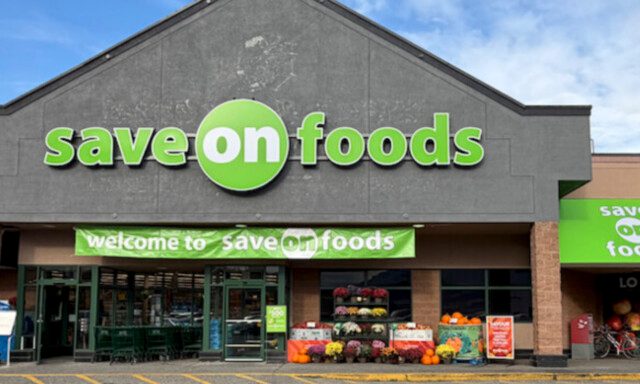
The Everyday Heroes on Our Front Lines
Every day, cashiers, stock people, and pharmacy workers wake up to serve our neighborhoods. They keep our pantries full, offer a friendly smile at the checkout, and form the backbone of local life. Yet, as Jamie Nelson, president of the Pattison Food Group, recently highlighted in an open letter, these essential workers are increasingly being put in harm’s way simply for showing up to do their jobs.
The situation has reached a critical breaking point. In Victoria, a store manager lost consciousness, suffered a concussion, and sustained severe injuries that will likely require surgical treatment after a brutal assault. Earlier this year, a arsonist deliberately set fire inside a Nesters Market store at Vancouver’s iconic Woodward’s building while staff and customers were inside. That attack caused over $500,000 in damage and temporarily closed the only full-service grocery store serving the Downtown Eastside. In the Okanagan, theft across Pattison Food Group stores has jumped 185 percent since 2021, while violent incidents against frontline security personnel rose by approximately 44 percent over the same period.
Personal Responsibility and Public Safety
Retail workers and local businesses are being subjected to bear spray attacks, knife threats, and violent altercations with homemade weapons. While Nelson rightly acknowledges the complex underlying issues surrounding addiction, mental illness, and homelessness, sympathy cannot come at the expense of basic public order. A compassion that ignores lawlessness is no real compassion at all—it leaves frontline staff exposed to constant fear and physical danger.
Local enterprise and practical community institutions cannot be expected to invest, provide essential services, or keep doors open without reasonable confidence that employees and customers are safe. When store operators spend heavily on security, training, and support programs only to see violent incidents escalate, it is clear that public authorities are failing in their most fundamental duty: maintaining public safety and holding repeat offenders accountable.
Protecting Those Who Build Our Communities
We cannot wait until a life is lost before deciding that enough is enough. As Nelson noted, the people most affected—the staff on the store floor—are often the least heard. They deserve to know that their safety matters, that violence will never be accepted as just another part of the job, and that they will return home safely at the end of every shift. It is time for every level of government to support our local workers with real accountability for repeat offenders rather than continued inaction.





OPINIONS
How Minor Parties and Strategic Balloting Could Shift the Upcoming B.C. Election
With B.C. Conservatives at 45% and NDP at 42%, experts weigh in on how vote-splitting among five parties and strategic voting could decide the election.


Narrow Polling Margin Points to Tight Provincial Contest
The Conservatives currently maintain a slight advantage over the governing NDP in B.C. polling averages compiled by 338Canada, holding 45 per cent support against the NDP’s 42 per cent. The B.C. Green Party registers at nine per cent, while support for two new right-leaning parties, CentreBC and OneBC, totals between two and seven per cent combined. A four per cent margin of error applies to the top two contenders in the aggregated data.
David Black, a political communications professor at Royal Roads University, explained that overall popular vote figures offer a limited picture of the final outcome. “We have 93 mini-elections that generate this complex outcome we call government,” he said. He added that the Conservatives maintain an edge, but noted the party’s recent internal instability under former leader Kerry-Lynne Findlay makes its long-term brand loyalty uncertain. “If this was a reliable, known, long-standing vehicle for the centre-right that was ideologically coherent and organizationally recognizable, then I would worry less about a vote-splitting,” Black observed.
Riding Dynamics and Strategic Voting Concerns
Small parties are not fielding slates in all 93 ridings across B.C., which impacts the precision of province-wide polling, noted Mario Canseco of Research Co. However, in ridings where candidates from CentreBC—headed by former Conservative Elenore Sturko—or OneBC—led by former Conservative Dallas Brodie—are present, vote-splitting could alter the results. Canseco noted that such dynamics could allow the NDP to secure seats with as little as 37 or 38 per cent of the vote, particularly across key toss-up ridings in Surrey.
Individual candidate races may also reshape local outcomes. In Vancouver-Quilchena, OneBC Leader Brodie is competing against Conservative Carson Binda of the Canadian Taxpayers Federation and NDP candidate Callista Ryan. Canseco calculated that if Brodie captures 10 to 12 per cent of the vote and Ryan replicates her 2024 performance of 38.91 per cent, the NDP could potentially win the traditional right-wing seat.
Party Leaders Respond as Election Nears
With five parties running incumbent candidates, NDP Leader David Eby warned that vote-splitting among left-leaning voters could inadvertently assist the Conservatives. He urged Green supporters to coordinate with his party to prevent a Conservative government. In response, B.C. Green Party Leader Emily Lowan rejected the call. “We look at the numbers; we know that the BC Greens grow the vote; we don’t split the vote,” she said.
Black emphasized that the NDP’s clearest route to victory relies on Green supporters, and to a lesser extent CentreBC voters, casting strategic ballots. Polling data from Research Co. shows that Green supporters express lower commitment to their choice compared to voters backing other parties. Eby acknowledged the likelihood of a tight finish, stating, “I think that what the polls do illustrate for me, and what I hope they illustrate for British Columbia, is that this election is going to be very close.”
THE OKANAGAN CURRENT | EDITORIAL | OCTOBER 12, 2026
By Chad Dashly | The Current News Desk
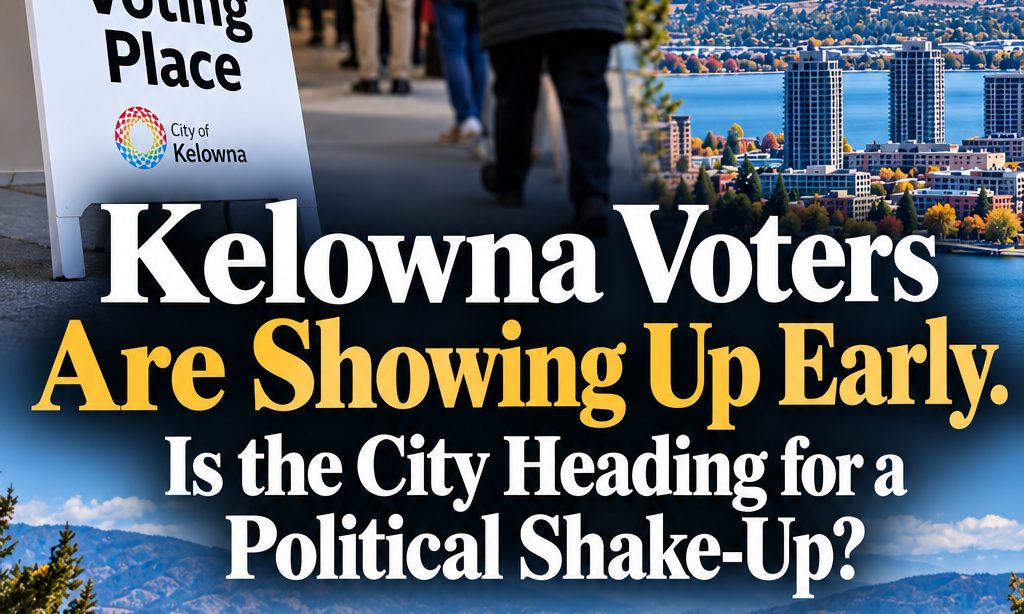
Kelowna voters are sending a message before election day even arrives. The question is whether City Hall is prepared to listen.
On October 7, 2,712 Kelowna residents cast ballots during advance voting, compared with just 1,471 on the equivalent day in 2022. That represents an extraordinary 84 per cent increase.
In neighbouring Lake Country, the numbers were equally striking. Advance ballots jumped from 342 to 709, more than doubling the previous election’s first-day participation.
These are not insignificant numbers. They suggest an electorate that is paying attention, increasingly motivated and perhaps more determined than ever to have its say about the direction of local government.
But before political operatives start celebrating, there is an important distinction worth making.
Higher advance turnout does not automatically mean higher overall turnout. And it certainly doesn’t tell us who is winning.
What it does tell us is that thousands of residents have decided this election matters enough to vote early.
That alone deserves attention.
Is this a vote for change or a vote for stability?
Kelowna’s mayoral contest features three candidates: incumbent Mayor Tom Dyas, former Conservative MP Ron Cannan and challenger Andrew Uitvlugt.
All three participated in the October 8 Chamber of Commerce debate, giving voters an opportunity to assess their competing visions for the city’s future.
But this election should not be reduced to personalities, campaign slogans or polished debate performances.
Kelowna residents have legitimate questions about what their municipal government has accomplished, where it has fallen short and whether the next four years will produce meaningful improvements.
Public safety remains a major concern. Homelessness and addiction continue to challenge neighbourhoods and businesses. Housing affordability has placed enormous pressure on families, while property taxes, infrastructure demands and traffic congestion have become unavoidable kitchen-table issues.
These are the concerns that should define the election.
For Dyas, the challenge is defending his administration’s record and convincing residents that continuity will deliver better results.
For Cannan, the challenge is demonstrating how his experience in federal politics and previous municipal service would translate into practical solutions at City Hall.
For Uitvlugt, the challenge is persuading voters that his alternative offers the experience, judgment and workable policies necessary to govern a growing city.
Each candidate deserves to be judged by the same standard: not what they promise, but what they can realistically deliver.
City Hall cannot blame Victoria for everything
One of the most frustrating features of municipal politics is the tendency to promise solutions to problems that municipal governments do not fully control.
Crime and repeat offending involve policing, provincial prosecution policy and federal criminal law.
Homelessness requires cooperation among municipalities, provincial housing agencies, health authorities and community organizations.
Healthcare delivery is primarily a provincial responsibility.
Yet municipal governments are not powerless.
City councils make decisions about land use, local infrastructure, municipal budgets, development approvals, bylaws and community priorities. They also have a responsibility to advocate effectively when provincial decisions affect local residents.
A mayor cannot single-handedly reform Canada’s justice system. But a mayor can demand accountability, establish measurable municipal objectives and build partnerships that produce visible results.
The next mayor should be expected to explain precisely which actions fall within City Hall’s authority, which require provincial cooperation and how progress will be measured.
Anything less is political theatre.
The 2022 election offers an important lesson
Four years ago, Tom Dyas defeated incumbent Colin Basran by a substantial margin, securing 21,328 votes and approximately 62 per cent of valid mayoral votes.
That result demonstrated something important: when voters become dissatisfied with the direction of their city, political change is possible.
Dyas himself benefited from that desire for change. Today, he must defend his own record against challengers asking voters to consider another direction.
City of Kelowna
+1
But interpreting the latest advance-voting numbers requires caution.
Some residents may simply prefer voting early. Others may be responding to greater election publicity, convenient voting opportunities or heightened interest in local issues.
The 84 per cent increase is evidence of stronger first-day participation, not proof of a political revolt.
Nevertheless, candidates who dismiss this surge would be making a mistake.
Provincial politics are part of the equation
Kelowna’s municipal election cannot be separated entirely from the broader political environment in British Columbia.
Provincial decisions on housing, healthcare, public safety, infrastructure funding and economic development directly affect what municipal leaders can accomplish.
The same voters choosing a mayor are also watching how their provincial representatives advocate for the Central Okanagan.
That creates an accountability question extending beyond City Hall.
Are Kelowna’s provincial MLAs effectively representing local priorities? Are municipal and provincial leaders cooperating, or simply pointing fingers when difficult issues remain unresolved?
And will the political energy visible in this municipal election carry into future provincial contests?
Those questions deserve serious attention, although municipal advance-voting figures cannot reliably predict provincial riding outcomes.
October 17 is about more than choosing a mayor
Kelowna is growing, changing and confronting pressures that cannot be solved through another round of political promises.
The next mayor and council will face difficult decisions involving taxation, development, public safety, infrastructure and the city’s long-term economic competitiveness.
Voters deserve clear answers, realistic commitments and measurable accountability.
For Cannan, Dyas and Uitvlugt, the final days should be about explaining exactly what they intend to change, how they will pay for it and why residents should trust them to deliver.
The encouraging news is that more citizens are participating early.
Whether they are voting for change, stability or something entirely different remains unknown.
But one thing is certain.
Democracy works better when citizens show up. Government works better when elected officials understand they can be replaced.
On October 17, Kelowna voters will decide whether City Hall has earned another four years of confidence.
And this time, judging by the early numbers, considerably more people may be determined to have their say.
OPINIONS
B.C. Election Poll Puts Conservatives Ahead Five Points as Cost of Living Tops Voters’ Concerns

The BC Conservatives lead the BC NDP 48% to 43% among decided and leaning voters in a new Angus Reid Institute poll. Cost of living is the top concern, named by 57% of respondents, followed by health care at 42%.
By Chad Dashly | The Current
A new Angus Reid Institute poll puts the BC Conservatives five points ahead of the BC NDP, but the closer look is more complicated than the topline suggests: both parties have gained support, voters are beginning to settle on their choices, and the issues they want leaders to address are firmly rooted at home.
The online survey, conducted October 1–3, found that 48% of decided and leaning voters would support the BC Conservatives, compared with 43% for the BC NDP. The poll was released after the nomination deadline finalized most parties’ candidate slates.
The Institute says both major parties gained support during the early campaign. It attributes Conservative gains in part to a smaller pool of CentreBC and OneBC candidates competing across the province, while the NDP appears to be drawing support from the Greens. Those are the pollster’s explanations for the shifts; the results do not establish why individual voters changed their minds.
The survey also found a more settled electorate. Nearly half of respondents, 46%, said they were “very certain” of their vote, up from 35% in the first week of the campaign. That confidence is not evenly distributed: among Conservative supporters, the share who were very certain rose from 47% on September 24 to 65%. Among NDP supporters, it reached 44%, a three-point increase from the campaign’s opening week.
The poll’s issue findings are just as notable. Cost of living and inflation were the leading concerns, selected by 57% of respondents. Health care followed at 42%. The economy and jobs, housing affordability, the provincial deficit and public safety each registered at 24% to 26%.
U.S. tariffs, Donald Trump and the alcohol ban were named as a top voting issue by 10%, down from 15% in the September 22–24 survey. The Institute’s question allowed respondents to choose up to three issues. The numbers suggest that, for many voters, the cost of daily life and access to care are more immediate concerns than the cross-border dispute that featured prominently in the NDP’s case for an election.
What the poll means
The five-point Conservative lead is a snapshot, not a prediction of the final result. The vote-intention figure is based on 846 decided and leaning voters, while the wider survey included 1,013 B.C. adults. Angus Reid says the overall results were weighted to represent the province’s adult population. Its stated margin of error—plus or minus three percentage points, 19 times out of 20—applies to a probability sample of that size; this was an online panel survey, so that comparison should be treated as a guide rather than a guarantee of precision.
The more useful campaign signal may be the contrast between the two parties’ apparent momentum and the issues voters are naming. The Conservatives lead, and their supporters report a marked increase in certainty. But the NDP has also gained ground, and nearly half of respondents still do not describe themselves as very certain. There is room for the race to move.
The issue rankings also set a practical test for both leaders. Voters are pointing to affordability and health care. Broad arguments about leadership, campaign tactics or national politics may draw attention, but parties still have to show how their plans would affect household costs and people’s ability to get care.
In the poll’s results, Conservative leader Lorne Doerkson holds a narrow edge over David Eby on who would make the best premier: 36% choose Doerkson and 33% Eby. Nearly as many, 31%, choose neither. That last figure is a reminder that a lead between party options does not automatically translate into broad enthusiasm for either leader.
As the campaign advances, the question is whether the parties can turn their current support into votes—and persuade uncertain voters that their promises answer the concerns showing up most clearly in the polling.
Source: Angus Reid Institute online survey conducted October 1–3, 2026, among 1,013 B.C. adults. Vote intention is based on 846 decided and leaning voters. Read the poll and methodology.

Vancouver Canucks Honour Beloved Broadcaster John ‘Cheech’ Garrett During Home Game

Why B.C. Lions Starters Are Resting as the Regular Season Concludes Against Winnipeg

How Minor Parties and Strategic Balloting Could Shift the Upcoming B.C. Election

Why Alberta’s Government Is Ruling Out Future Separation Votes

BC Conservatives Promise Forestry Overhaul to Revive Jobs as NDP Points to Millions in Existing Investment
Your Current 3 Day Forecast — October 22, 2026
Opinion: John Rustad Has to Go
B.C. Supreme Court Grants Cowichan Tribes Title to Historic Richmond Lands and Fishing Rights

A Taste of Autumn: Fall Okanagan Wine Festival 2025

Vancouver Canucks Gear Up for a Make-or-Break 2025–26 Season

Kamloops Blazers Announce Off-Season Changes Ahead of 2025–26 Season
BC Ferries Sparks Outcry Over Contract with Chinese Shipyard
-
BC STORIES6 days ago
Why a Major Political Shift is Shaking Up the B.C. Provincial Election Final Weekend
-

 POLITICS6 days ago
Why Incumbent Harwinder Sandhu Is Asking Vernon-Lumby Voters for Another Term
-
4 days ago
Your Current 3 Day Forecast — October 18, 2026
-
5 days ago
Your Current 3 Day Forecast — October 17, 2026
-

 LOCAL6 days ago
Volunteer Dive Team Uses Farming GPS Technology to Bring Closure to Grieving Okanagan Family
-
3 days ago
Your Current 3 Day Forecast — October 19, 2026
-

 COMMUNITY5 days ago
Recovery of missing paddleboarder on Okanagan Lake brings closure to family and community
-

 COMMUNITY3 days ago
Why a Downtown Kelowna Favorite Is Say Goodbye After 45 Years