COMMUNITY
Why a Familiar Kelowna Voice and Castanet Reporter Is Reflecting on a 50-Year Career
Castanet reporter Wayne Moore retires after nearly 50 years in BC media, reflecting on his broadcasting career, community news work, and sports coverage.


Longtime Reporter Concludes Nearly 50 Years in Media
Veteran media personality Wayne Moore is stepping back after nearly five decades in the industry, reflecting on a career that spanned radio broadcasting and digital journalism across British Columbia.
Moore started his journey on a Monday evening in September 1978 at CHQB in Powell River. Over the years, his work took him to Port Alberni and Kelowna, where he held positions at CKOV and CKIQ before joining SILK/Castanet. His involvement with Castanet began as a volunteer covering the 2003 Okanagan Mountain Park fire, turning into a 23-year career with the outlet.
Highlights and Continued Community Involvement
Though his dream of calling play-by-play for the Vancouver Canucks did not happen, Moore called major sports milestones, including the Okanagan Sun’s first national championship in 1988 and the West Kelowna Warriors’ RBC Cup championship run in 2016. Throughout his career, he covered prime ministers, premiers, and community members, aiming to maintain factual accuracy and professional standards.
Moore expressed gratitude toward his family, including his wife of 18 years, Shawn, and his sons, Kevin and Scott, alongside several early mentors and colleagues who assisted him throughout his career. While retiring from full-time reporting, Moore plans to stay involved in local sports by covering teams from press boxes in the city.








COMMUNITY
Middle-Income Renters to Benefit From 129 New Apartments in Rutland
Troika breaks ground on a 129-unit apartment building in Kelowna’s Rutland, featuring 51 middle-income units, an on-site daycare, and transit perks.

New Multi-Family Development Underway on Dougall Road
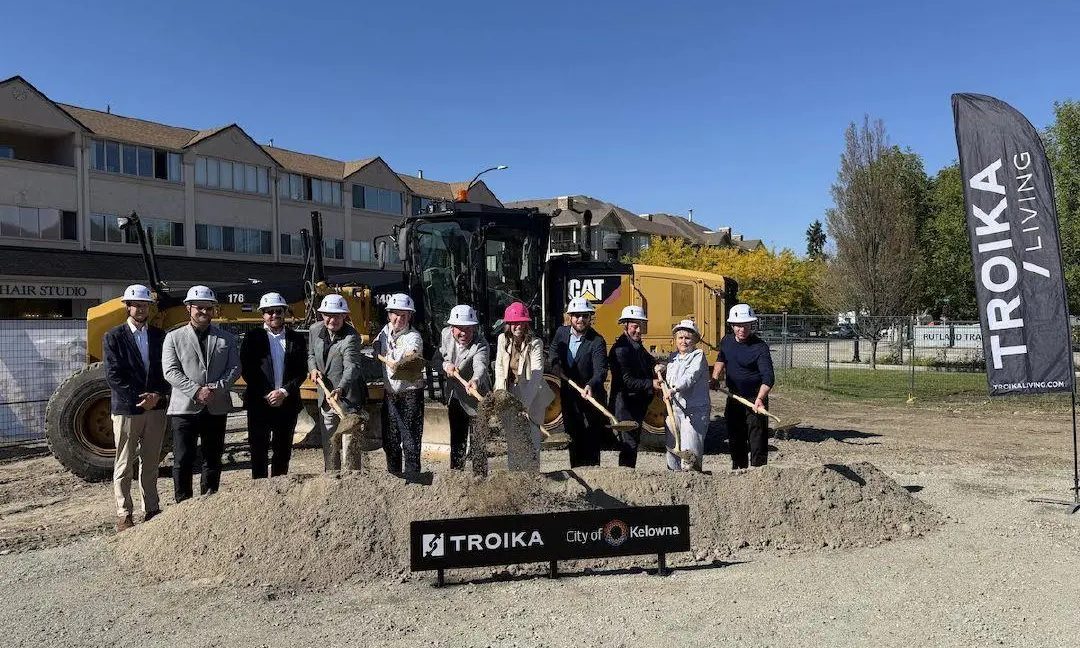
Construction has officially commenced on a six-storey rental development in Kelowna’s Rutland neighborhood. Developer Troika held a small ceremony alongside partners and staff on Sept. 17, using gold shovels to mark the start of work at 155 Dougall Rd. North.
Affordable Rents and Family Amenities
The project is being constructed in partnership with the City of Kelowna via its Middle Income Housing Partnership. According to Troika CEO Renee Merrifield, 51 of the planned 129 units are “reserved for income qualified middle income households.” The complex will offer studio apartments as well as one, two, and three-bedroom floor plans.
Families living in the complex will have access to an internal 3,902-square-foot daycare featuring an outdoor play area. Additional facilities include a fitness centre and a rooftop amenity space.
Transit Integration and Eco-Friendly Features
Located adjacent to the Rutland Transit Exchange, the location was selected with local transportation in mind, explained Troika Vice President of Construction Kerry McDowell. To encourage sustainable travel, 17 parking stalls will be EV ready. Every household will also be provided with a complimentary Modo car share membership along with a $100 usage credit for first-time members.
Furthermore, residents will have access to a prepaid eco pass transit fund totaling nearly $200,000 to cover transit fares. Addressing the long-term vision for the property, Merrifield stated, “We will be here carefully managing the building, caring for it and supporting the people and community that grows within it.”
BC STORIES
Why B.C. Farms Are Struggling: New Study Explains the $457 Million Sector Loss
A UFV report reveals that while B.C. farms suffered a $457M loss in 2024, commercial sites earned $770M as rising debt and costs strain mid-sized operations.

Commercial Farms Retain Profitability Despite Heavy Sector Losses
A recent study by the University of the Fraser Valley (UFV) offers a fresh look at British Columbia’s agricultural landscape, clarifying that a reported $456.9 million aggregate loss for 2024 was largely driven by small-scale, sub-commercial operations. Commissioned by the BC Agriculture Council and BC Dairy, the report revealed that 74.4 per cent of the province’s farms generated under $100,000 in annual operating revenue, with over 40 per cent earning less than $10,000.
Study author and UFV assistant professor of agriculture Chris Bodnar highlighted that while these sub-commercial sites account for most of the net financial deficit, B.C.’s 4,100 commercial farms—representing 25.6 per cent of all agricultural properties—remained profitable. Commercial operations generated approximately $770 million in net operating income in 2024, achieving a 13.2 per cent profit margin. Overall output remains concentrated among top earners: less than four per cent of farms generate over $2 million in gross sales, yet they produce 68 per cent of B.C.’s total farm revenue.
Mid-Sized Operations Face Growing Financial Pressure
Despite commercial profitability, the UFV report warns that mid-sized farms generating between $500,000 and $1.99 million in revenue are rapidly shrinking. B.C. currently counts 1,150 mid-sized farms, but the segment has seen steady declines since 2015, dropping by five per cent in the $500,000 to $1 million category. By contrast, while Canada saw a two per cent decline in similar mid-sized operations nationwide, the country experienced a 39 per cent increase in farms making between $1 million and $2 million.
Bodnar noted that mid-sized farms serve as key indicators of broader industry health because they lack the outside income often supporting sub-commercial farms and cannot absorb shocks as easily as large corporate entities. Rapidly escalating expenses are compounding these pressures. Between 2022 and 2024, vegetable and beef producers saw labor costs increase by 4.9 per cent and 4.6 per cent, respectively. B.C. commercial farms also pay higher rent than the national average across nearly all sectors, with tree fruit and nut growers paying more than twice the Canadian average. Additionally, local poultry and dairy operations face feed costs six to seven per cent higher than national levels.
Surging Farmland Values and Debt Escalation
Soaring land values and expanding debt loads are further incentivizing mid-sized farmers to exit the industry. Farmland valuations in B.C. climbed 67 per cent between 2015 and 2023, while provincial farm debt has ballooned by 286 per cent since 2004—growing faster than in any other province. Bodnar pointed out that B.C. remains the only major agricultural province in Canada lacking a dedicated agricultural lending institution.
Danielle Synotte, executive director of the BC Agriculture Council, noted that the report provides factual validation for long-standing concerns regarding B.C.’s unique cost pressures. BC Dairy general manager Jeremy Dunn emphasized that clear data is vital for supporting future sector investment, noting that stability on the farm yields widespread economic and food security benefits across the province. Detailed findings are accessible via the UFV study portal at farmingattheedge.ca.
BC STORIES
How Kelowna Is Positioning Itself as a Future Hub for AI Wildfire Drones
Kelowna partners with FireSwarm Solutions, YLW, and Okanagan College to launch an AI drone and aerospace innovation hub focused on wildfire suppression.

Partnerships Aim to Establish B.C. Aerospace Hub
New agreements have been signed to transform Kelowna into a centre for artificial intelligence-enabled drone and aerospace development in British Columbia. The initiatives connect the City of Kelowna, Kelowna International Airport (YLW), Okanagan College, and FireSwarm Solutions, a Canadian aerospace and defence startup that specializes in autonomous drone swarms for wildfire suppression and emergency response.
Two separate Memorandums of Understanding were established: one between FireSwarm and the municipal government, and another between the startup and Okanagan College. The goal is to demonstrate how technology created for emergency situations can be applied across civilian, dual-use, and sovereign sectors.
Building Wildfire Tech and Local Training Programs
The collaboration builds on an initial 2025 field test at Knox Mountain, where the Kelowna Fire Department integrated FireSwarm’s automated drone technology to evaluate its effectiveness in wildfire fighting. That exercise was monitored by Transport Canada, the BC Wildfire Service, and additional agencies.
To support the growing industry, work is already underway at YLW on a new dedicated training hangar funded through Okanagan College and the BPL Legacy Association. Okanagan College plans to launch specialized programs focused on aircraft maintenance engineering for uncrewed systems, avionics, drone structures, and advanced manufacturing. Leaders from the city, college, and FireSwarm emphasized that building a skilled workforce alongside technological advancements will strengthen economic growth and bolster regional wildfire resilience.
Your Current 3 Day Forecast — September 20, 2026

Dylan Cease struggles as Toronto pitching strain worsens in loss to Rangers
How Canada’s Prime Minister Is Building Stronger Trans-Atlantic Ties Close to Home
Montreal’s High-Powered Offense Holds Off Late Hamilton Comeback in East Clash
What to Know Ahead of Alberta’s Oct. 19 Vote on a Separation Referendum
What to Know About the Alasko Frozen Raspberry Recall Following Illness Reports
Opinion: John Rustad Has to Go
B.C. Supreme Court Grants Cowichan Tribes Title to Historic Richmond Lands and Fishing Rights

A Taste of Autumn: Fall Okanagan Wine Festival 2025

Vancouver Canucks Gear Up for a Make-or-Break 2025–26 Season

Kamloops Blazers Announce Off-Season Changes Ahead of 2025–26 Season
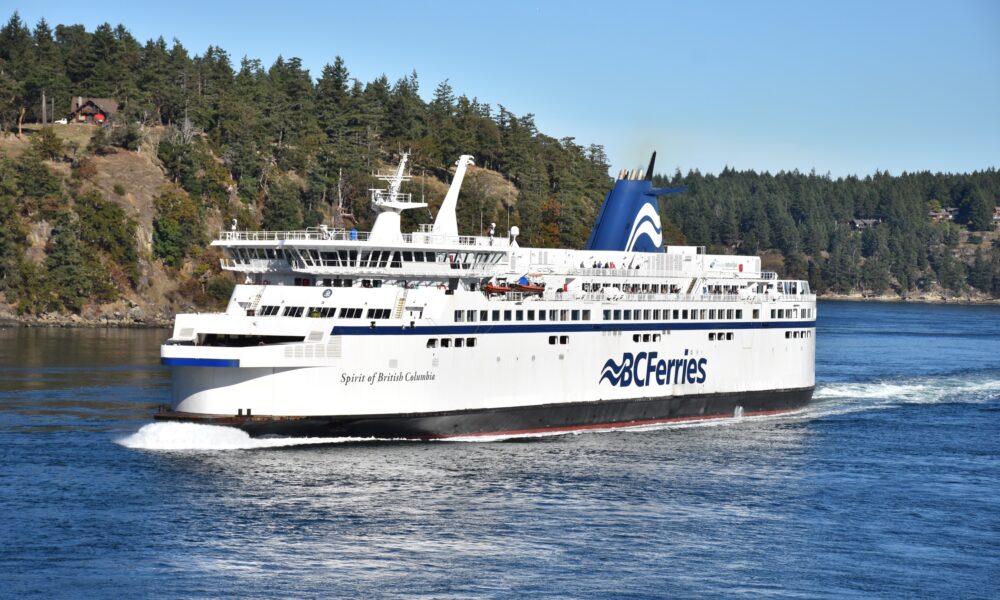
BC Ferries Sparks Outcry Over Contract with Chinese Shipyard
-
NATIONAL STORIES6 days ago
Remembering George Chuvalo: The Canadian Heavyweight Legend Who Never Got Knocked Down
-

 COMMUNITY6 days ago
Navigating Blended Family Wills and Estate Options
-
 SPORTS6 days ago
How Video Adjustments Fuelled the Vancouver Canucks’ 5-2 Prospects Victory Over Seattle
-

 NATIONAL STORIES6 days ago
AI’s Biggest Warning May Be Coming From the People Building It
-
POLITICS7 days ago
What Trump’s Remarks Linking Canada to Iran Signal About International Negotiations
-
WORLD7 days ago
What Trump’s Remarks Linking Canada to Iran Signal About International Negotiations
-
LOCAL7 days ago
Stephen Johnston Mayor by Acclamation
-

 BC STORIES6 days ago
Uncertain Eyewitness Testimony at Center of Final Arguments in 2021 Restaurant Shooting Trial